
How to Start a Bridal Alterations Business

Nadine Bozeman, owner and bridal seamstress of Sweet Francis Sewing Co., reviewing wedding gown alterations details during a bridal studio consultation.
A practical, strategic guide for seamstresses ready to build a profitable bridal alterations business
Bridal alterations is a specialized craft, and, just as importantly, a business that must be run with intention, strategy, and confidence.
Whether you’re thinking about transitioning from general alterations, expanding an existing wardrobe-alterations workload, or taking your home sewing skills into a profitable entrepreneurial direction, this guide will walk you through everything you actually need to know to start a bridal alterations business- grounded in the practices shared across the Secrets of a Bridal Seamstress community.
What Is a Bridal Alterations Business (And Is It Right for You?)
When most sewists think about bridal, the first thing that comes to mind is the dress itself — the lace, the tulle, the sparkle. But bridal alterations isn’t about sewing alone.
It’s about:
✔ Precision under pressure
✔ Emotional client management
✔ Clear business systems
✔ Pricing that reflects value
✔ Strategic workflows that protect your time and skills
In other words, your technical ability matters, but your business mindset matters just as much (if not more!).
Many bridal seamstresses feel intimidated to take the leap because they lack confidence in running a business- from pricing to marketing to communication and beyond!
If this sounds familiar, don’t worry! These skills can be mastered with an intentional strategy just as you mastered your sewing skills.
Step 1 — Clarify Your Skill & Confidence Baseline
Bridal alterations is advanced sewing. As a bridal alterations specialist, you need to be well-versed in:
Interior structural support
Complex fitting techniques
Bustles (American, French, ballroom)
A variety of hemming techniques (lace, tulle, satin, horsehair)
Invisible zipper replacement
Delicate lace appliqué removal and re-placement
Shoulder, neckline, and sleeve reshaping
…oh and we know the list keeps growing with each new bridal trend!
A successful bridal alterations business starts with confidence in what you can deliver, not just what you hope to learn! This is a high-stakes craft, and precision is always expected.
However, please don’t read this exhaustive list and feel defeated if you’re not super confident in each of these skills. Your confidence and skill set will grow with each wedding gown you alter.
Start with the skills you have today, and only accept the gowns you know you can confidently sew with those skills!
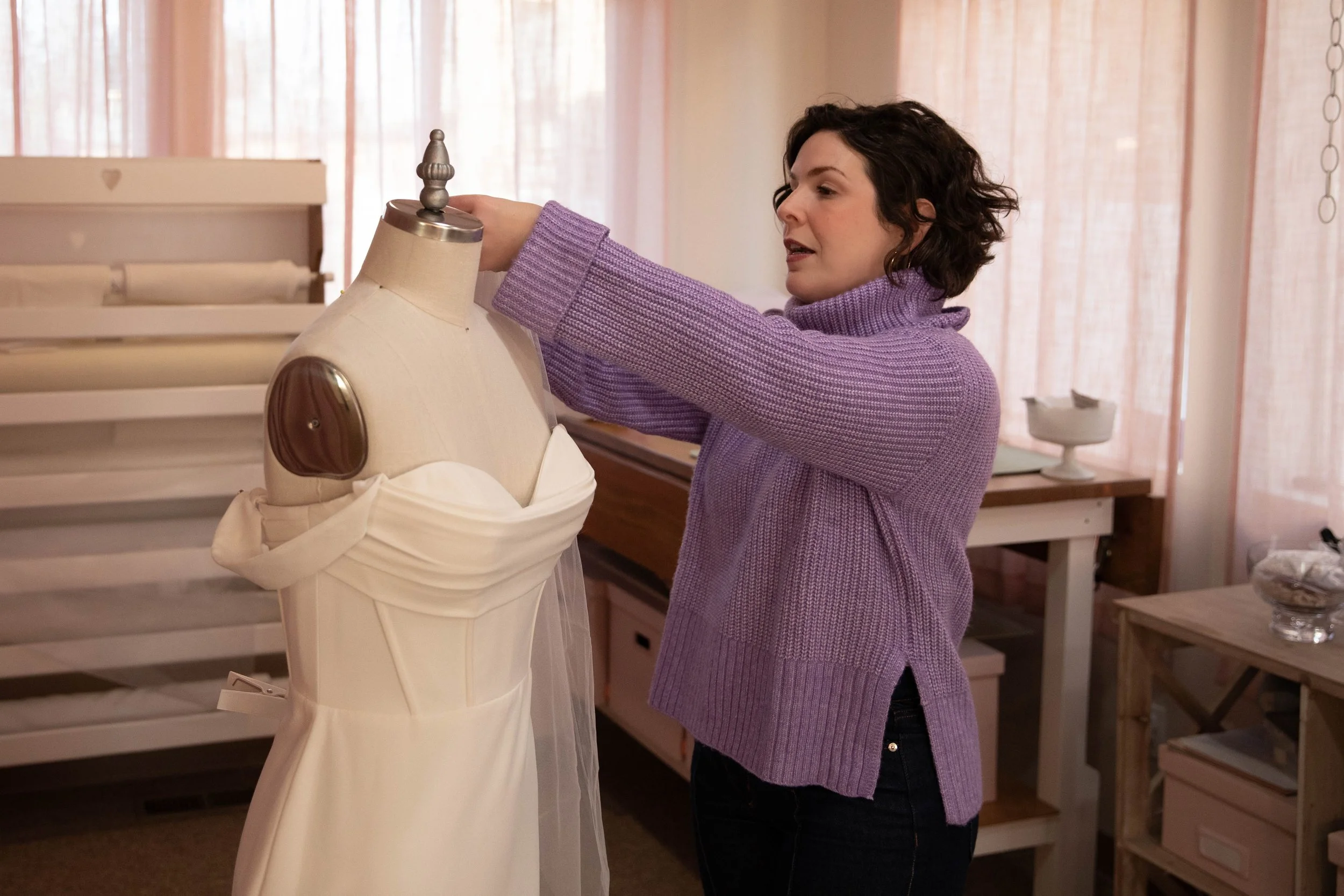
Nadine Bozeman adjusting the bodice of a wedding gown on a dress form in her bridal alterations studio.
Step 2: Choosing Your Bridal Seamstress Business Model
There are three primary ways to structure a bridal alterations business:
Home-Based Bridal Studio
This is the most common launchpoint.
Pros:
Low overhead
Lower risk: you can build a business without the pressure of making rent
Ability to work around family or children’s schedule, for both fittings and sewing time
You can more easily update your home studio as the business grows, and enjoy tax breaks on the square footage!
Cons:
Requires self-discipline
Scheduling can sometimes be difficult at times to work around family!
Professional boundaries can sometimes be more difficult to establish
Wedding gowns need a clean storage space away from pets and closed off from food smells
If you want to take a chance on your bridal dream business with the space you currently have available, this is a great model!
Retail Space
Pros:
Higher visibility
Professional storefront presence
Separation from home space and work space is an important consideration for some sewists, especially as a business grows
Cons:
Higher monthly costs
Often requires team management sooner
This model works best when your pricing, client volume, and systems are stable enough to support rent and staff.
Boutique Partnership / In-House Seamstress
Pros:
No marketing responsibility
Minimal hands-on experience for the business side of things; this is often a sewing-only position.
Cons:
No pricing control
Bridal shops typically keep a high percentage of each ticket
Limited autonomy with scheduling and workload
This is an employee position, not considered an entrepreneurial career.

Bridal alterations fitting area in a studio with gown storage and private consultation space.
Step 3: Legal and Financial Setup for a Bridal Alterations Business
Most creative entrepreneurs skip this step- but you cannot afford to! These responsibilities aren’t as exciting as the sewing and the marketing and the vision boards, but trust me- they’re the foundation of a successful business. Just take one small step at a time.
You got this!
To start a bridal alterations business responsibly:
✔ Register your business
LLC, sole proprietor — whatever suits your state and liability tolerance. A quick Google search for your state’s business licensing website can provide side-by-side information for both options.
✔ Get liability insurance
Bridal gowns are expensive! One mistake can be costly and you don’t want to wait until that happens to find out just how costly…
✔ Separate business banking
This is non-negotiable. If your business money mixes with personal, your financial clarity disappears. Plus, it’s actually very fun and motivating to open a business account and watch it GROW! Think of this step as you telling yourself ‘Hey, it’s time to make some money with this awesome skill set!’
✔ Implement bookkeeping
Know what you’re making, what you’re spending, and what you owe. I cannot stress enough how valuable this foundational habit is. Knowing your numbers is powerful, and it prevents you from feeling like a ‘victim’ of your finances. You are the captain steering this financial ship!
Initially, overseeing your own bookkeeping is very manageable. But as the business grows and your time becomes more precious and the numbers become more intimidating- consider outsourcing to a professional bookkeeper.
Bridal alterations business owners often feel insecure about “professional details” (marketing, taxes, legal protection) until they learn to strategize them. In Secrets of a Bridal Seamstress Membership, you’ll receive step-by-step instructions to make these overwhelming details habitual and even easy.

Nadine Bozeman reviewing business paperwork and planning details in her bridal alterations studio.
Step 4: Bridal Alterations Pricing — How to Charge for Profit
This skill set will strengthen with time, experience, and confidence. I’ve worked with so many incredible seamstresses who struggle with pricing even after years of proven excellence in their craft.
They price based on:
What they think clients will pay
What they think competitors charge
What they think their work is worth
That’s not strategy. That sounds like a fear and emotion-based way to set professional pricing!
Proper pricing for bridal alterations considers:
✔ Your technical time
✔ Communication time
✔ Email, booking, and appointment coordination
✔ Fittings
✔ Expertise under pressure
✔ Overhead, taxes, profit margin
If you undercharge, you will:
✘ Work too many hours
✘ Breakdown your own boundaries
✘ Erode your confidence
✘ Burn out faster than you expected
Profit begins with a pricing structure that protects both your time and sanity, and one that attracts your ideal bridal clients
Step 5: Creating a Wedding Dress Fitting Process That Protects Your Time
Bridal fittings require a predictable rhythm. This helps you gauge not only how many clients you should accept each month, but a rhythm helps you accomplish all the tasks on time.
Here’s a simple fitting timeline that protects your margins and your schedule:
First Fitting
12–14 weeks before the wedding
Second Fitting
6–8 weeks before the wedding
Final Fitting
1–2 weeks before the wedding
This structure gives you breathing room, gives the client peace of mind, and it ensures that the gown will fit perfectly on the wedding day.
You’ll find the right rhythm that works best for your personal life and that also gives you enough time to prepare the gowns for 2nd and 3rd fittings. Give yourself grace to find your own groove! If you’re feeling a little overwhelmed by your current rhythm (or lack thereof?) ask other seamstresses how they structure their sewing and fittings. There’s no wrong way- you just want to find what feels best for you!
Step 6 — Master Client Communication
One of the biggest struggles bridal seamstresses face is communication, especially under pressure! Most negative client experiences can be avoided with clear and kind communication.
Perhaps even more important than your sewing skills are your communication skills. (ok maybe not more important…but it’s nearly a tie!)
Excellent communication means that you:
Set expectations clearly and fairly
Document agreements
Share timelines early
Confirm appointments in advance
Handle difficult conversations with neutrality and professionalism
Step 7: How to Get Bridal Alterations Clients
If you want bridal clients, you must be discoverable. Brides are searching for wedding vendors on social media and through good old fashioned Google searches. Your branding visibility can expand through:
A website (think basic: a home page, an about page, and a contact page)
An Instagram account
A Facebook page
Social media builds connection, but search visibility drives consistent inquiries.
Although you don’t need to be a marketing guru just yet, a basic understanding of SEO and social media will help you get started. There are many free website builders that are user-friendly and can allow you to build a 3-page website in a weekend. The key here is that finished is better than perfect! There’s no pressure to have an elaborate, custom website right off the bat. You just need a place on the internet for your new business to live.
For your SEO crash-course, think about what brides would include in a Google search:
bridal seamstress near me
bridal alterations price range
wedding dress fittings timeline
Your website should have educational content that answers these common queries. Keep it simple. Your website can be updated anytime! You can add blog posts, FAQ sections, and service pages optimized for bridal searches.
But for now, focus on giving your business a home on the world wide web.
Step 8: Setting Boundaries and Avoiding Bridal Season Burnout
This step is not optional!
Listen, bridal season can be intense! If you don’t have:
✔ Appointment cut-offs
✔ Rush fee structures
✔ Maximum weekly booking limits
✔ Clear cancellation policies
✔ Communication boundaries
…your business becomes a little monster camouflaged in pretty fabrics!
Boundaries protect your time, energy, sanity, and reputation.
Your craft deserves respect, and more importantly, your life deserves balance.
Your boundaries are part of your brand, and they’ll define how you experience this beautiful business you’re dreaming of.
Step 9 - What Does it Mean to Build Systems in a Bridal Alterations Business?
Reliable systems help you run your new business with predictability and ease. You should have documented processes for:
✔ New client intake
✔ Contracts
✔ Appointment scheduling
✔ Payment collection
✔ Alteration checklists
✔ Final delivery procedures
You should not be reinventing the wheel for every client. Systems save energy, reduce mistakes, and help you grow with confidence.
Step 10: How Much Do Bridal Seamstresses Make?
I’m so glad you asked! The answer varies based on:
Pricing
Demand
Location
Systems
Overhead
Capacity management
A well-structured bridal alterations business can realistically earn $100,000+ annually.
But this only happens when:
✔ Pricing reflects skill and value
✔ Systems protect time
✔ Boundaries preserve energy
✔ Marketing attracts ideal clients
Common Mistakes When Starting a Bridal Alterations Business
Here’s what most new bridal seamstresses regret:
-Underpricing work
-Lacking documented systems
-Taking every client who inquires
-Communicating reactively
-Operating without boundaries
-Trying to do it all alone
Nadine Bozeman, bridal seamstress and owner of Sweet Francis Sewing Co., standing confidently in her bridal alterations studio.
Final Thoughts: Build Your Bridal Alterations Business Like a CEO
Bridal alterations is not just sewing. It’s also:
✔ Strategic pricing
✔ Systems engineering
✔ Professional communication
✔ Search-driven marketing
✔ Confident execution
Starting a bridal alterations business is one thing, but building a sustainable career with clarity and confidence is another. Secrets of a Bridal Seamstress has resources in place to help you in your bridal sewing journey.
If you want ongoing education, honest industry conversations, and practical business strategy, start with the Secrets of a Bridal Seamstress podcast.
